Formation of startups and new companies
Commercial exploitation of science, technology, and novelty
System of laws, regulations, strategies, and funding priorities
Discovery and creation of new knowledge of the natural world
Technological Advancements in the world.
By Murtaza Haider, Published at Dawn.Com on November 2, 2011
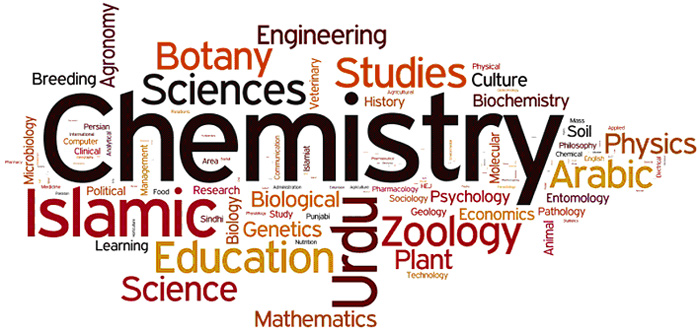
A recent public opinion poll revealed that the top-most research priority areas identified by Pakistanis included Chemistry, Urdu literature, Islamic studies, Arabic, Botany and Zoology. Those who responded to the survey asked of Pakistani academics to devote their energies on the above-mentioned research areas and requested the governments to fund additional research in Chemistry and other basic sciences.
You are not alone in wondering how you missed seeing the results of this critical opinion poll in which Pakistanis identified research priority areas for the nation. In fact, no such poll exists. But what exists is a list of 7,151 Ph.D. dissertations completed since independence in Pakistan, which shows that most frequent research subjects included Chemistry, Urdu literature, Islamic studies, Arabic, Botany and Zoology.
The following graph is a pictorial representation of the subject areas used to categorise the 7,151 doctoral dissertations. The size of each subject area is in proportion to how frequently it appeared in the list thus revealing Chemistry and other basic sciences along with Islamic studies and Urdu being the most common research areas for doctoral dissertations in Pakistan. Education and agronomy are rare examples of frequent research topics that address immediate needs in Pakistan.
 By Dr. Athar Osama
On 12 April 1961, Russia’s Yuri Gagarin became the first man to orbit around the earth in Space. Soon after, United States launched its own quest to conquer space. Kennedy’s vow to send a man to the moon before the end of the 1960s, unleashed an unprecedented race to gain and demonstrate scientific knowledge and technological knowledge between the two super powers.
Soon enough, American Neil Armstrong took the ‘one small step for a man,’ that became ‘a giant leap for mankind’ and rest, as they say, is history. The 1970s became a decade, when man dreamt of venturing farther and farther, into the exciting corners of the galaxy and creating co...
By Dr. Athar Osama
On 12 April 1961, Russia’s Yuri Gagarin became the first man to orbit around the earth in Space. Soon after, United States launched its own quest to conquer space. Kennedy’s vow to send a man to the moon before the end of the 1960s, unleashed an unprecedented race to gain and demonstrate scientific knowledge and technological knowledge between the two super powers.
Soon enough, American Neil Armstrong took the ‘one small step for a man,’ that became ‘a giant leap for mankind’ and rest, as they say, is history. The 1970s became a decade, when man dreamt of venturing farther and farther, into the exciting corners of the galaxy and creating co... By the Editors of Muslim-Science.com
Dr. Rana Dajani obtained a Ph.D. in molecular biology from the University of Iowa, USA; a Fulbright alumnus, she is currently Assistant Professor and Former Director of the Center of Studies at the Hashemite University, Jordan. Her research focuses on genome-wide association studies concerning diabetes and cancer in ethnic populations in Jordan. Other research includes signaling transduction, stem cells, and bioinformatics.
She is a strong advocate of the theory of biological evolution and of its compatibility with Islam. On the broader horizon, Dr. Dajani has developed a community-based model and philosophy, “We Love Reading (WLR)...
By the Editors of Muslim-Science.com
Dr. Rana Dajani obtained a Ph.D. in molecular biology from the University of Iowa, USA; a Fulbright alumnus, she is currently Assistant Professor and Former Director of the Center of Studies at the Hashemite University, Jordan. Her research focuses on genome-wide association studies concerning diabetes and cancer in ethnic populations in Jordan. Other research includes signaling transduction, stem cells, and bioinformatics.
She is a strong advocate of the theory of biological evolution and of its compatibility with Islam. On the broader horizon, Dr. Dajani has developed a community-based model and philosophy, “We Love Reading (WLR)... By: Tan Sri Dr. Omar Abdul Rahman
At the 34th convocation of UPM in October 2010 in my “ucapan balas” for the conferment of emeritus professorship of the university, I had suggested a defined new role for our public universities in line with current emphasis in national development. Because they are expected to, and in the position of contributing to the government’s socio-economic transformation program, I had suggested they be called transformational universities (TUs). What prompted me to do so was also the active discourse on the changing role of universities that has been going on for a number of years in academic circles in the West.
For example, during a...
By: Tan Sri Dr. Omar Abdul Rahman
At the 34th convocation of UPM in October 2010 in my “ucapan balas” for the conferment of emeritus professorship of the university, I had suggested a defined new role for our public universities in line with current emphasis in national development. Because they are expected to, and in the position of contributing to the government’s socio-economic transformation program, I had suggested they be called transformational universities (TUs). What prompted me to do so was also the active discourse on the changing role of universities that has been going on for a number of years in academic circles in the West.
For example, during a... By:Athar Osama
Published on SciDev.Net on 18 May 2012
Building a knowledge society in the Islamic World requires structural change — not fads and symbolism, argues Athar Osama.
Last month, a special report by The Economist magazine announced the dawn of the third industrial revolution, built on the idea of individualised production powered by 3D printers and nano devices that create objects atom by atom. [1]
It talked of a not-so-distant age when the global centre of gravity of production — which in the 1970s moved to developing countries like China, Malaysia, Taiwan — will revert to the developed world, in order to be nearest to the ‘brains’....
By:Athar Osama
Published on SciDev.Net on 18 May 2012
Building a knowledge society in the Islamic World requires structural change — not fads and symbolism, argues Athar Osama.
Last month, a special report by The Economist magazine announced the dawn of the third industrial revolution, built on the idea of individualised production powered by 3D printers and nano devices that create objects atom by atom. [1]
It talked of a not-so-distant age when the global centre of gravity of production — which in the 1970s moved to developing countries like China, Malaysia, Taiwan — will revert to the developed world, in order to be nearest to the ‘brains’.... The Islamic world’s current science effort is on life support and without major ‘surgery’ could be yet another policy failure, says Athar Osama.
In 2007, the Organisation of Islamic Cooperation (OIC) created the Science, Technology and Innovation Organisation (STIO) to jumpstart science cooperation among its 57 member countries. Three years later, a founding meeting approved an annual budget of US$70 million, with four founding members — Iran, Pakistan, Saudi Arabia and and Syria — committing US$5 million each to the budget.
To date, 20 countries have joined STIO — but none has honoured its financial commitment, according to the organisatio...
The Islamic world’s current science effort is on life support and without major ‘surgery’ could be yet another policy failure, says Athar Osama.
In 2007, the Organisation of Islamic Cooperation (OIC) created the Science, Technology and Innovation Organisation (STIO) to jumpstart science cooperation among its 57 member countries. Three years later, a founding meeting approved an annual budget of US$70 million, with four founding members — Iran, Pakistan, Saudi Arabia and and Syria — committing US$5 million each to the budget.
To date, 20 countries have joined STIO — but none has honoured its financial commitment, according to the organisatio... By Zakri Abdul Hamid –
Science Adviser to the Prime Minister of Malaysia
For Malaysia, the past three decades have been a period of rapid and sustained growth. Measuring growth with the traditional Gross Domestic Product yardstick, Malaysia’s economy has increased more than a hundredfold. Over the past four decades, we have averaged nearly 7% annual growth. Poverty rates have fallen from 49%, to less than 4%. Per-capita GDP has risen from US$370, to more than US$9,000.
This growth has been matched by a fundamental change in the structure of our economy. Like many Asian countries, we have moved from a basis of agriculture and raw commodities to a multi-sector eco...
By Zakri Abdul Hamid –
Science Adviser to the Prime Minister of Malaysia
For Malaysia, the past three decades have been a period of rapid and sustained growth. Measuring growth with the traditional Gross Domestic Product yardstick, Malaysia’s economy has increased more than a hundredfold. Over the past four decades, we have averaged nearly 7% annual growth. Poverty rates have fallen from 49%, to less than 4%. Per-capita GDP has risen from US$370, to more than US$9,000.
This growth has been matched by a fundamental change in the structure of our economy. Like many Asian countries, we have moved from a basis of agriculture and raw commodities to a multi-sector eco... By: Dr. Athar Osama
Muslim-Science.Com met with Tan Sri Dr. Omar Abdur Rahman, Mahathir’s Science Advisor for over a decade and half and, the “prime mover” behind Mahathir Mohammed’s vision of a Knowledge-driven Malaysia. A deeply humble man, Tan Sri Omar insists that Mahathir was a science policymaker par excellence in his own right and that he would hardly have needed a science advisor. However, he played a critical role in providing scientific credibility to Mahathir’s plans and helping the Prime Minister reach out to the scientific community to build support for his policies.
As Malaysia’s first and longest serving Science Advisor – a position t...
By: Dr. Athar Osama
Muslim-Science.Com met with Tan Sri Dr. Omar Abdur Rahman, Mahathir’s Science Advisor for over a decade and half and, the “prime mover” behind Mahathir Mohammed’s vision of a Knowledge-driven Malaysia. A deeply humble man, Tan Sri Omar insists that Mahathir was a science policymaker par excellence in his own right and that he would hardly have needed a science advisor. However, he played a critical role in providing scientific credibility to Mahathir’s plans and helping the Prime Minister reach out to the scientific community to build support for his policies.
As Malaysia’s first and longest serving Science Advisor – a position t...